
Simply by the fact that this website exists I think the majority of you would be able to confidently assume my response to the above question. I will also say that this is the question I asked myself before considering recommending my sometimes questionable methods while studying Japanese. In many ways it could be considered that I have ruined video games for myself and I want to say first and foremost that is not my intention and that I truly would like to help those who are learning to simultaneously enjoy the content they own as well as use it to it’s most beneficial potential.
Languages in games
Video games are a huge industry, increasing at a baffling rate and with no signs of slowing down any time soon. Like others from my generation I grew up in the earlier era of gaming where things looked less polished and were only really know by a minority of society. Flash forward to now and it is a staple for killing time rivalling television. Commuters can often be found playing mobile games that far surpass what was capable back in the early 90’s, children and the elderly have access to consoles that are far more family friendly and both indie and AAA games have reached expansive heights in all genres and functionalities.
The beauty of this widespread gaming is that many games are available in a variety of languages. In much the same way that some learners enjoy using anime for learning Japanese, video games can be used in the same way but as with all things there can be pros, cons and hurdles to watch out for.
The upside
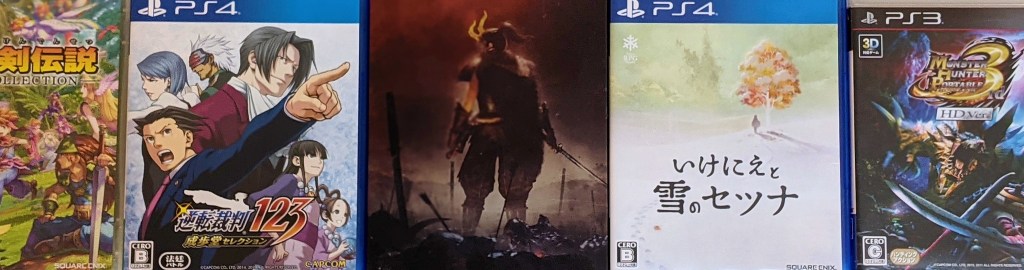
In exactly the same way as TV, books and educational mediums, videogames can have either a very broad and widely used vocabulary or they can be more niche, with vocabulary that may not be used frequently elsewhere but that may hold more of a personal interests to other hobbies e.g history, cooking or sports. The level of reading content can be incredibly helpful especially if it’s something that also grabs your attention personally. The strongest aspects of games that make them such a powerful tool is their interactability. Again this differs from game to game but you can be sure that for the most part the game won’t proceed unless you understand what it’s asking you to do.
Word heavy or dialogue orientated games such as the Phoenix Wright, Persona or Monster Hunter collections force you to recognize repeated or vital words in an environment that is more engaging than skimming textbooks. Also if you have a fondness for a particular genre you will find burst of motivation and pride from carrying across newly learnt words and visibly seeing your progress. Aside from written language if you can find the right games you can also discover voice acted cutscenes, with or without subtitles to round off additional skills needed for learning. The best case scenario is a game that is engaging, understandable and most importantly, immersive. Immersive games in not just Japanese but any target language will massively improve your recognition and make you feel centered in what you are trying to learn.
Last but not least, a love of these games can spill out from your consoles and into your day to day life. If you have the passion for it you can find many gaming resources online that add fuel to your progress. Hard copies of Japanese video games, Game guides in Japanese both physical and online, merchandise and additional content. In the same way that you can in your native language you can show your appreciation for your favourite titles and even find communities with the same passion. If you’re lucky enough to have friends playing games and learning Japanese you can also enjoy local play or online multiplayer.
The Downside
Learning a language takes focus, commitment and dedication, regardless of how you study. There is no easy way to learn and it’s easier than you think to get burnt out, disheartened or angry when you plateau. When playing games you can draw a fine line between playing to studying and losing focus, slipping into just playing through muscle memory. Another aspect to be cautious of is that no characters or menus in the game are going to explain complicated linguistic features like the grammar they’re using. Characters of different regions will also speak in different ways and if you aren’t willing to stop and think about how someone is speaking it can have a diminishing effect on your progress. I will not say that any game in Japanese is bad for learning but obviously some will be better than others, and that’s mostly what I’m here for. Everyone out there will find a game (or games) that grips them and gives them their best possible progress.
I find the best way to ensure I am focused when playing is to have a notebook or whiteboard easily accessible, make sure you are comfortable but not too comfortable (I doubt you’d be studying effectively sunk in a bean bag with snacks) and take the game in slowly. Many games have textbox dialogue, where the textbox won’t leave the screen until you push the button to proceed, in these cases don’t go forward until you’ve at least attempted to read what you see. Take a note of Kanji or words that show frequently, if you’re in a menu you’ll be seeing a lot then stop and make sure you can read the tabs and options. The best tool to play games and learn is not the controller, it is your dictionary and your willingness to understand.
Methods
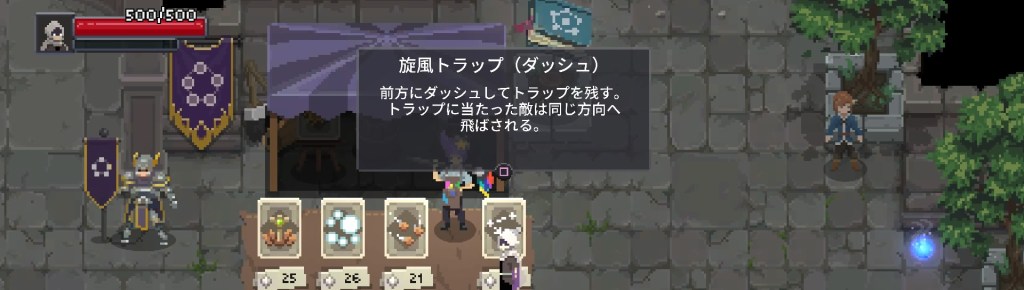
One great thing you can do with games is create challenges or smaller games within them. Setting yourself goals of “I want to be able to read every character bio” or “Let’s see if I can go through this cutscene and catch every word” will not only keep your target in mind but it will also make more fun out of the game and will aid in taking vocabulary in passively. I first did this with Wizards of Legend, a favourite study game of mine, where I worked to read every item I came across. From this I learnt a ton of new words that I may not have even considered learning.
I cannot stress this enough, if you come across a word you don’t know in a game, look it up. On many occasions if I was testing a game or was daunted by a lot of text I would skim read only the words I knew but I was losing out on so much content. If you can encourage yourself to look up new vocab while you are playing you will be amazed at how frequently you’re seeing the same words and maybe missing out on good repetitive practice.
In conclusion
Yes, play games to learn but do not take it for granted that just playing a game in Japanese will improve your language directly. It is a tool, take the time to really think about the dialogue being used and who is saying it. More importantly, enjoy being able to understand more and more content, as your language becomes better you will need to grind less, and just like reading books in English, it’ll become less like hard work and closer to just enjoying content in your target language with relative ease.
Go play some games, see the game library here on Games and Kanji and let me know if you have any recommendations for games or games that you may be struggling to understand.
 Games & Kanji