The year is 2025. While we don’t have flying cars (at least not on a commercial level), advancements from a computing standpoint continue to develop. It wasn’t long ago that artificial intelligence was considered scary and too risky to approach however, now you’re hard pressed to go a day avoiding it. Most people even work their day jobs reliant on the guidance of ChatGPT and other uber-intelligent bot services. For some time the question of the impact of AI on language has also garnered attention. The concept of having a “Hitchhiker’s guide”-esque babelfish are becoming worryingly real, making the idea of learning a language seem almost pointless. As such I wanted to talk around my reality and the changes AI has made to my working “career” as an all-round linguist. Is it a good thing? Do I enjoy it? Does it terrify me? Currently that’s a “No”, “No”, “Yes”, but let’s look at why…
So, as some of you may already know, I’ve got a background in a few fields relating to language. From the day I started learning languages I’ve added more and more hats, strings, avenues (or whatever other analogy you’d like to use) to my proverbial catalogue. First and foremost I consider myself a learner but also a teacher, a translator, an entertainer and all around culture lover. I spend everyday studying and wholeheartedly encourage others to do the same if they have the goals and the interest to do so. Language has so much to offer and every field can benefit from those who wish to yield it.
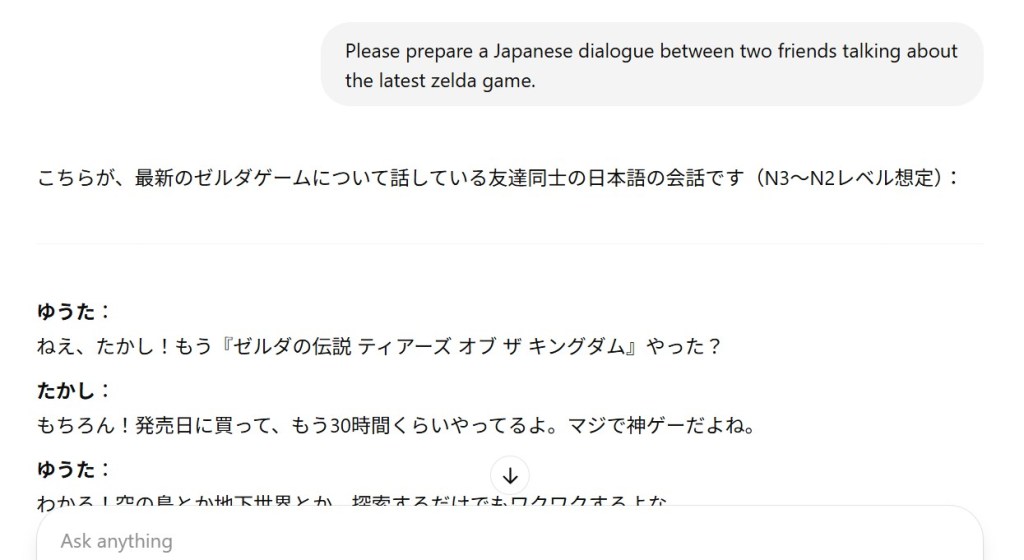
Learning a language can be done in so many ways and with a variety of types of media. While these are essentially infinite, it can sometimes be tricky to find something engaging and to a suitable academic level. Games that you want to play may be too fast paced or cumbersome, novels may be a step too far in terms of difficulty and music may just be catchy, but not actually helpful. AI tools are predominantly word based but they are increasingly flexible and allow you to tweak topics, difficulty, style, length and more. Simply asking ChatGPT to generate a dialogue or a set of example sentences can provide valuable resources that suits your current proficiency level perfectly. Don’t get me wrong, ChatGPT will never substitute for a well invested tutor. Tutors can provide direction, familiarity, talk around their own pitfalls, laugh and empathize with you, all without the need for you to provide the prompts. Natural conversation is exactly that, natural.
As a teacher, my thoughts towards AI are split. Obviously, AI tools can generate reems of content without the need for any R&R and therefore trying to compete is a losing battle, especially considering AI doesn’t need to earn a wage. On the other hand, the same content that a student can make can also be made by the experts, potentially even to a better standard when you have some of the peripheral knowledge already. The content can also be made into the form of lesson plans, with time frames and exercises sprinkled in for good measure. If you’re in a position where you need 100 test questions which would be the likeliest option; stop all other tasks and invest the time to generate each question yourself, or give a simple prompt and simply review the results to make sure they’re not completely outlandish? I feel like AI is a handy supplement to a teacher’s arsenal, and said teachers should not feel guilty for using it (maybe I’m trying to make myself feel better…) but, as stated, a teacher who cares for the progress of their students is hard beaten.
The area in which my gripes and fears really amass is translation. I love translation. It’s tough, lengthy and can be entirely up to interpretation, but it is rewarding and beneficial for the recipient and the translator. In all honesty, I started translating before I was proficient enough to do so. I thought I could learn and be paid to do so (to a certain degree I was right, and still am) but it also became a driving force to learn more. I wanted to be able to translate as quickly as possible and had the bonus of learning vocabulary translating topics I might not have otherwise come across. It is, or I suppose was, easily the most profitable aspect of this little brand I’ve grown over the years.
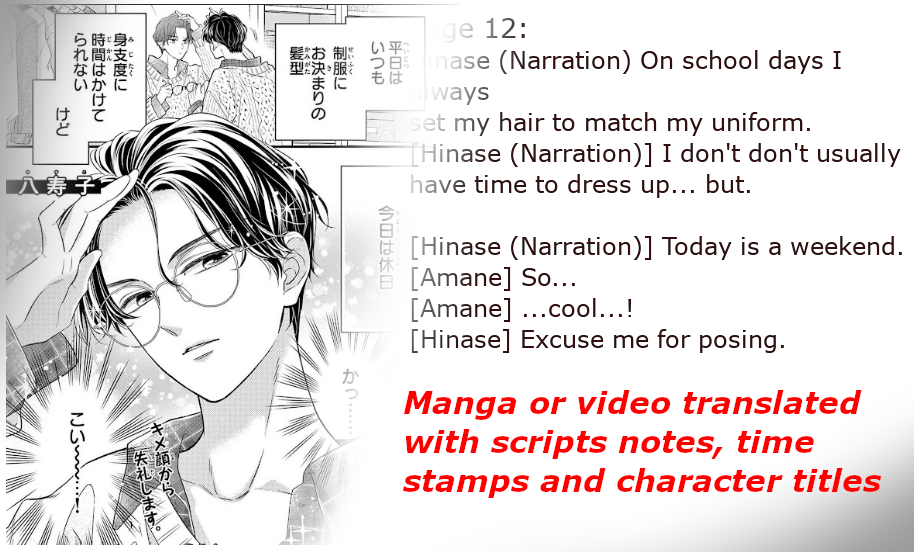
In the advent of AI translation comes improvements specifically focused on manga, books and audio subtitling. We’re no longer competing with Google translate’s hilariously off-the-mark antics. Instead we’re up against a sophisticated, example fueled machine that can rip the kanji out of speech bubbles and swiftly throw English in its place in beautiful formatting. All for either a low cost or none at all. We cannot compete. I’ve wanted to be a full time translator for many years now, I now know this is increasingly unlikely to happen. The big names are already established and it’s rare that people will pick up the little guys when better options are out there. Sorry to be a little morbid, just know at least that I won’t quit as it’s something I truly love.
In a slightly more positive light, entertaining with languages is a more viable venture, or at least my recent musings have been. Language learning can be dull so it’s nice to have a bit of levity with like minded learners. Streamers and YouTubers are more and more common, each carving their own little niche in a sea of unending content. If you’re willing to trawl you can certainly find someone out there who suits your language level or preferences for certain topics (ahem…games) and so it seems like the demand for more will not be relinquished any time soon. I don’t believe AI can supply entertainment in the same way as us. We know what makes our fellow humans tick, and so entertaining feels like one of those jobs that’s safe from the grasp of any grandiose machine takeover. The problem is that people’s attentions are also fickle so even the best content may not last. Regardless, I’ll still be making videos and articles for as long as I can.

Culture is the most important thing in all this, both foreign cultures and our own personal cultures. I have a passion for Japan and no amount of machine learning is going to take that away from us. As I say, I do fear for others not picking up the mantle of learning languages and instead leaning on new tech as a crutch. I’ve had heart breaks in the past of previous students getting frustrated with their lack of progress months before a well planned trip to Tokyo only to turn around and say “I want set phrases only” or “I’ll just use Google translate”. I don’t begrudge them. At no point will I ever force someone to continue learning if they don’t wish to do so, however if they’ve dreamt of that fluency but decide it’s not worth the hassle due to promises of speedy, automated (but ultimately false) fluency then I can’t help but feel deflated. This won’t stop me from wanting to work towards my own fluency and I will forever be an advocate of properly understanding what you say, not just regurgitating dollar store phrase books. Culture, and our interest in it, is why we continue. Not for money, not for stature, but just to bring us joy. It’s a bit soppy I know, but it is an emotional and very current topic. I’ve established this small base to call my own but other budding translators and teachers may not have done so.

I’m aware I’ve possibly gone on a little bit of an emotionally heated rant, but in summary, we’ll all continue to use AI and it’ll likely become even more impressive. Before long globalization will have no limitation, which should be a beautiful thing and I should accept it for exactly what it could be. AI will bring the world together in the same way that quashing the Amazon makes room for homes. I think my overall feelings can be summed up by a simple but profound quote from G. Michael Hopf, “Hard times create strong people, strong people create good times, good times create weak people, and weak people create hard times”. That’s not to say that we’ll become weak as a society, just perhaps that the incentive for hard work and difficult study may fade with time and the easiest and most universal route will become the norm. This isn’t a new or original thought by any means, it just seems to have come to fruition sooner than I expected.
If you’re someone who is studying hard and wants to ingrain language into themselves, know that myself and other language learners are proud of you. Use AI if you’d like, reap the benefits described here, define new methods and genuinely revel in the improvements you can achieve from it. You are completely welcome to disagree with my slightly doomsday-y ramblings. Even as I write this I feel like my slightly old-fashioned view of the world may be shrinking in the rear view, that it may just be my linguistic anxieties coming to the surface. I suppose all we can really do is knuckle down, get to work and see what the next 5 years brings!
For any of you out there that do want to build your language knowledge and wander the streets of Japan without fancy headphones or whizzy apps, those who want to see the joy in local’s eyes as you speak without assistance to them about topics they enjoy, let me know. I’ll always have time for those who want to learn.

 Games & Kanji