
If you are here it is likely you have read the previous two lessons on Hiragana and Katakana. If not, please do so as only a madman would endeavour to learn kanji without them. Kanji is the 3rd script of Japanese that most people learn and contains a varying amount of characters depending on the source. Some records state more than 50,000 kanji (enough to scare anyone off) however you will likely only need a collection of daily use kanji, also known as Jo-yo- kanji, to get by and navigate Japan. These total around 2,000 kanji, which is still quite a lot but you’ll get familiar with these quicker than you may think. Let’s take a look into the make up, usage and nuance of kanji below!
The use and rules of Kanji
漢字
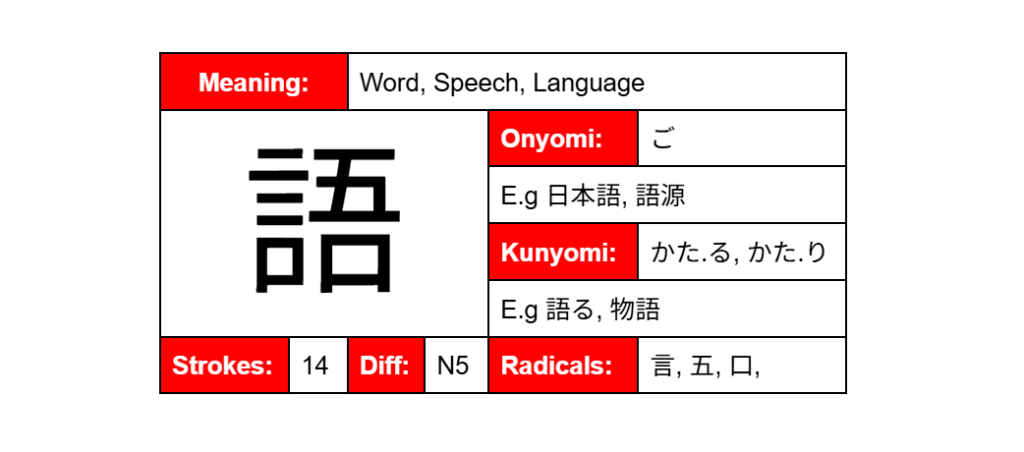
As you can see from the above diagram, kanji isn’t just as simple as a character with a singular sound like we saw with hiragana and katakana. Instead a kanji’s reading can change dependant on the word it’s shows in. The reason for these multiple readings stems from the fact that the Japanese “borrowed” kanji from their Chinese counterparts over a thousand years ago and adopted some of the readings that came with it, known as on-yomi or sound reading, while still maintaining their original Japanese readings, also known as kun-yomi or native readings.
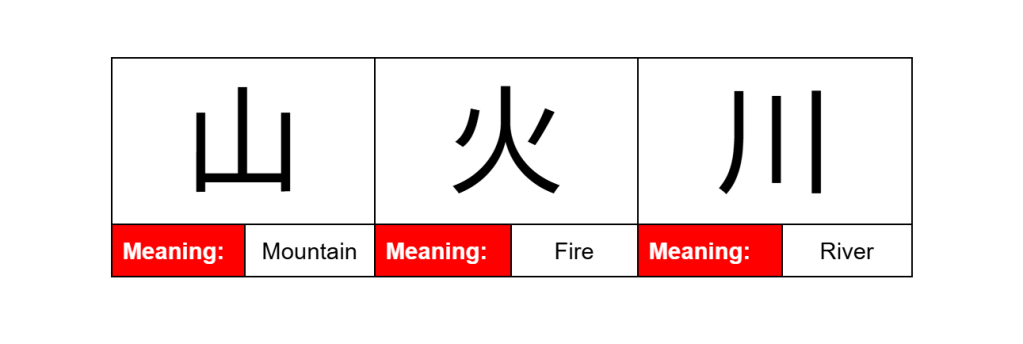
Kanji started its life as a pictographic language, using simple imagery of objects to denote meaning. For instance the kanji for tree, 木, looks quite close to the shape or representation of a tree (if you picture the roots and what-not). Many of the more simple kanji (typically ones with fewer strokes), such as the ones below, follow this pattern, however other kanji might need a bit more working out. Each kanji will often use a variety of smaller parts known as radicals, or ぶしゅ, that denote things such as meanings, categories, readings and more. There are around 200 radicals so I won’t go through them individually here (Maybe one day) but we will see a brief overview of how they work in the explanation below.
The make up of Kanji: Bushu
漢字の構成: 部首
Kanji radicals are groups of strokes that can be put in certain positions within a single kanji to add meaning or other functionality to it. These radicals often have characteristic positions, such as usually being found at the left or right, top or bottom, or even around other radicals within a kanji. This helps with differentiation and recognition but can also be a false friend, making some characters look very similar, so do be careful.
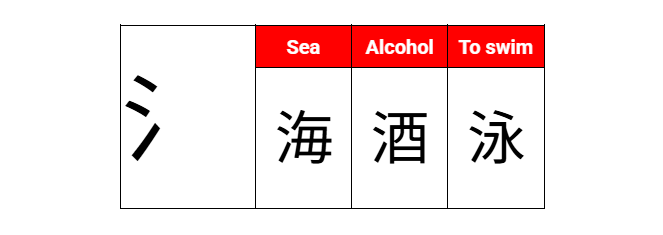
You can see that the 3 kanji below share a commonality. There are 3 short strokes on the left hand side in a consistent formation. The kanji below hold the meaning for “Sea”, “Alcohol” and “To swim”. The common theme between these is water, which is conveniently what this radical represents, anything related to or interacting with water.
This means that when you see a completely new kanji that contains this 3 stroke radical on the left hand side, you can quite confidently assume it has a connection to water in some way. Once you’re familiar with a healthy number of certain radicals you can recognise them quickly to help you guesstimate the correct meanings of new words and kanji.
The readings of Kanji and Furigana
漢字の読み方と振り仮名
As mentioned above, kanji can sometimes have more than 1 reading. A few kanji have as many as 20 or more readings, although luckily that doesn’t happen too frequently. There are general rules of thumb for these readings, however they aren’t always an exact science so the best way to get comfortable with individual readings is to find them in context, look them up and commit them to memory. This is where playing games and coupling it with the glossaries in the games library can help. You’ll see the way a word is written in kanji and its reading written out in hiragana to guide you.
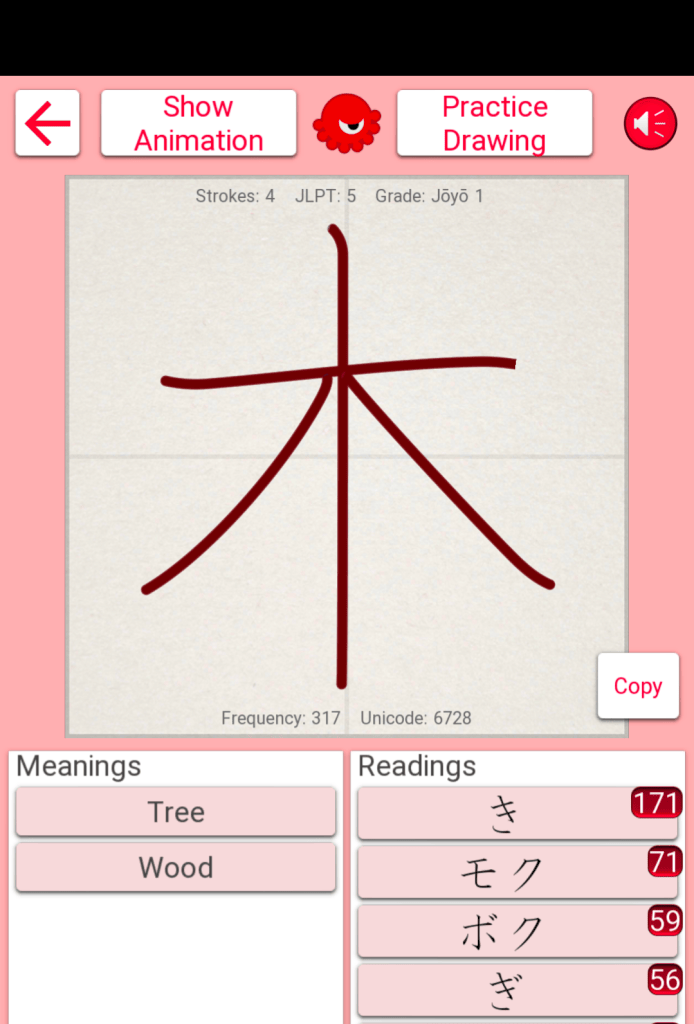
There are a number of tools to help with readings. Many dictionaries or online resources will provide databases of the most common words or words that contain common kanji. Some may also allow you to find words that share a particular reading of certain kanji. For instance, apps like Kanji Tree by Andrew SJ Innes will allow you to see every word where the kanji 木 is read as き, もく, ぼく or ぎ and will even show the frequency and number of words for each. This is a powerful tool to get an understanding of which readings will most likely be used in novel words you find.
Depending on the level of the source material you are reading, you may see smaller floating hiragana above the kanji called furigana, like we see in the below. Reading materials aimed at younger audiences or beginner learners will often feature furigana but you may also find that high level reading material will include furigana if a word is particularly rare or difficult.
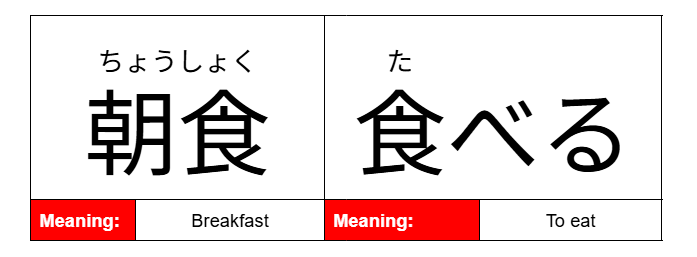
You’ll notice that the furigana in the example for “To eat” is only above the kanji, not the two hiragana to the right. This is because the hiragana will always be read as they are seen. You’ll also notice that there is a kanji shown in both examples that is the same, read as しょく in the left example and た in the right example. This is an example On-yomi and kun-yomi, with On-yomi typically showing in compound words made up only of kanji and Kun-yomi showing up in singular kanji words or in words that contain both kanji and hiragana. In this case the hiragana following a kanji are known as okurigana.
Compound Kanji and Okurigana
熟語と送り仮名
When kanji are combined to make compound words they form what is known as a 熟語 (じゅくご) or compound kanji word. This will be a word that often (but not always) takes the On-yomi of a kanji and has a meaning that is representative of the two kanji it contains.
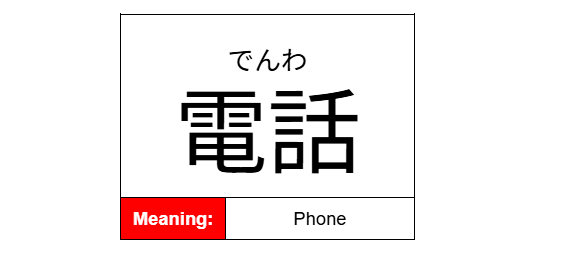
A good example of this is the word for phone. 電話, is made up from the kanji for electricity 電 (でん) and speech, 話 (はなし), which makes logical sense. Not all 熟語 will be as straightforward to comprehend as this but the general principle will remain the same.
Not all words containing kanji are 熟語 however. Many words, predominantly verbs like the 食べる example we saw above, feature a kanji at the start followed by hiragana. Okurigana provides more information on what the kanji is being used for. Sometimes you will find verbs in a dictionary that use the same kanji followed by different okurigana. This can change things such as if an action is passive or active or if a verb is transitive or intransitive. I hate most of these overly grammatical terms so let’s have a look at a quick example:
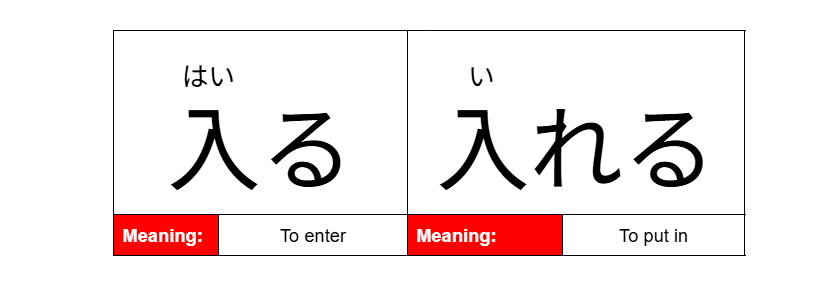
The kanji 入 focuses on things going into other things. Now that the giggling has stopped, you can see here that the furigana is very different. はいる, on the left, means you, I or someone else enters a location, such as a building, whereas いれる focuses instead on someone putting an object into something else, such as a book into a bag. Both overall ideas are the same, but if we were to use the kanji solely on its own it would be hard to discern the finer details of who’s conducting the action or what is being done to the object.
Okurigana also has another functionality in that it can be conjugated. Conjugation is the function of changing the ending hiragana of certain words in order to change the tense (present tense to past tense), the passivity (Active to passive), the potentiality (Can do to can’t do) and much much more. We won’t go into detail here as conjugations can take time to master, but rest assured that as you progress through each level of you Japanese language journey you’ll pick up a multitude of new conjugations on the way.
Combining Kanji: Rendakuten
連濁点
A common phenomenon that can aid with recognition and memory of the readings for a lot of the 熟語 (Compound words) is a change that can sometimes occur known as 連濁点 (れんだくてん). As we learnt in the hiragana lesson, many hiragana can have a dakuten or han-dakuten added to them to change the sound slightly. 連濁点 is when the readings of the 2nd, 3rd or later kanji in a compound word is dakuten’ed when found in certain words. This doesn’t always happen, and will only affect the first kana of the second or subsequent kanji if does occur.
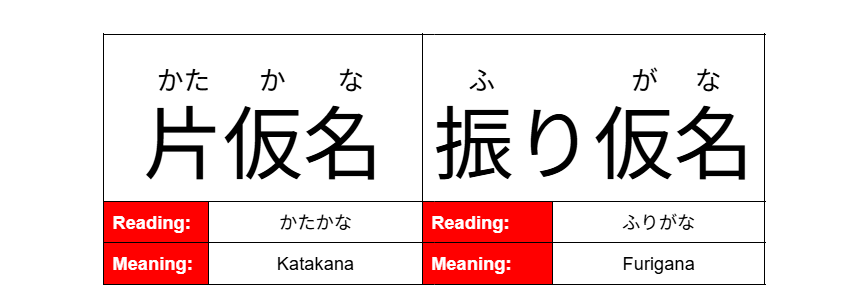
You’ve actually unknowingly seen this in words we’ve already seen so far. The word for character かな shows up in many words, such as ひらがな, かたかな, ふりがな and おくりがな. In many of those words, but not all of them, the か from かな has been dakuten’ed, turning into a が. This is done either because the flow of the word sounds smoother, having a softer sound, or because of glottal stops (Small つ) being easier to pronounce, such as in the word しっぱい, meaning failure (Of which you are not because you now understand rendakuten).
Repeated Kanji: Noma
々
Amongst all of the categories of characters we have learnt so far there is an oddity. There are many words which are made up from a repetition of kanji, showing either an increase in the number of something, plurals or a generalisation of a theme. For instance:
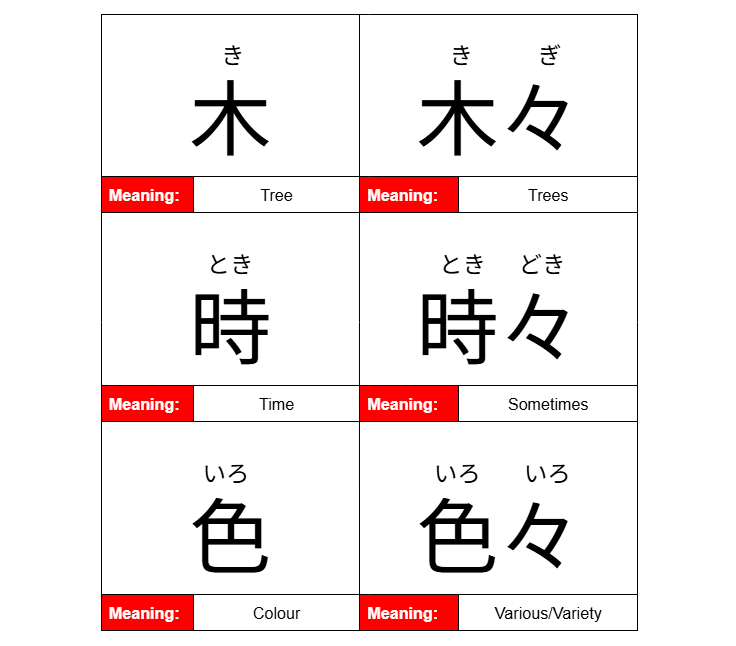
You’ll see now why it was important to learn about rendakuten. The character 々 is very unique as it doesn’t have it’s own reading and instead copies the reading and meaning of the previous kanji. In cases where the kana can be dakuten’ed you will often see this happening too. The reason why 々 is called “Noma” is because it looks like the katakana for ノ and マ together, and the reason why it exists and is used instead of simply writing the kanji twice is because writing kanji can be a pain! It genuinely exists as a way to ease the writing of certain complicated kanji that can be used twice in some compund words.
Putting it all together
あわせて いこう
I would love to say that’s another script done and dusted but alas, learning all of the kanji is a long and ongoing journey. The important thing is not to learn every single kanji you find though. Instead it is better to understand the rules and reasonings for how and why certain patterns occur and then be able to recognise them in the wild. I’m not going to lie by saying kanji is easy, but depending on your goals and motivations in the language it is necessary and invaluable. As an avid reader and lover of games, I spend most of my learning journey deciphering kanji, looking for known kanji in new words and using my understanding of kanji meanings to improve my reading comprehension.
My best advice for learning kanji, and new words in general, is to commit the kanji to memory as a complete unit. Don’t just learn the reading of a word, think about the kanji being used, what the meaning is, frequent readings and more. Build your kanji familiarity to the point where when you see kanji in a new word you may understand the meaning of the word before even knowing how it sounds. It’s a unique and rewarding feeling.
Let’s have a look at some examples of kanji words that follow the patterns learnt above. If you would like to memorise these words then do feel free but there is no obligation. This is just an exercise to check you’ve cemented your knowledge in modifying kanji:
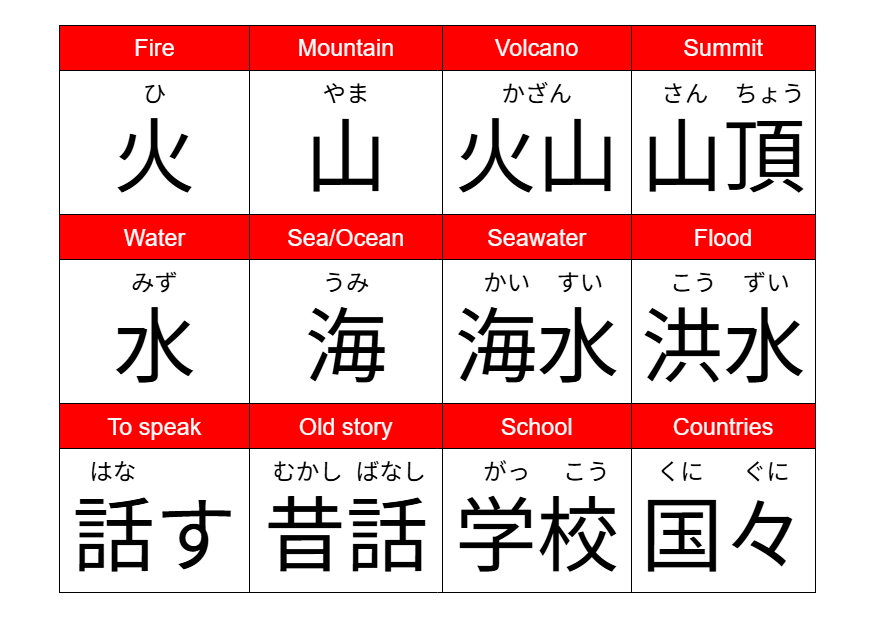
I hope you enjoyed learning about all of the intricacies of kanji. From here on out it’ll be a matter of learning as many words as possible, building your recognition of certain kanji and building your grammar. Now you’ve learnt about all 3 of the japanese scripts (We’ll ignore Romaji), you are well on your way to becoming and Japanese pro!
Glossary of terms 用語集
Jo-yo- Kanji = Kanji classified as everyday use Kanji, made up from the Japanese word 常用. This covers 2,136 Kanji that will allow you to read
Reading = The way in which a word, often written in kanji or a combination of kanji and hiragana, is pronounced. Often denoted using hiragana above the word, known as furigana.
Furigana = Hiragana characters written above or next to kanji to show the specific reading of the kanji when in that position of the word. Often used to guide low level learners or show the readings for rare and difficult words.
On-yomi = Derived from the words “sound” and “reading” and refers to the way that the Chinese reading of the original Hanzu sounded.
Hanzu = The name of the original Chinese characters that Kanji were derived from.
Kun-yomi = Derived from the words “practiced” and “reading” and refers to the original Japanese reading of vocabulary given to kanji after its introduction to Japan.
Pictographic = Based on pictures to illicit meaning.
Stroke = The brush or pen strokes used in order to write hiragana, katakana and kanji. In kanji, characters are often characterized by their stroke count when being searched for in dictionary tools.
Radical = A group of strokes that are representative of an idea or concept and can be used to make up components of a kanji. Radicals can also be kanji by themself.
Okurigana = The hiragana that follows a kanji in a word contain both kanji and hiragana.
Jukugo = A compound word made up only of multiple kanji.
Passive = Describes an action where the subject of the sentence receives or participates but isn’t directly actioning.
Active = Describes an action carried out directly by the subject of the sentence.
Transitive = Describes a verb that needs an object to be actioned by the subject.
Intransitive = Describes a verb that occurs with no object required.
Conjugation = Changing the ending of verbs and adjectives in order to alter the tense, passivity, potential or focus of that word.
Rendakuten = The second or subsequent kanji in a jukugo word being modified with dakuten or han-dakuten in order to ease pronunciation and flow of the word.
Noma = A character that is written in place of a duplication of kanji in the same word.

